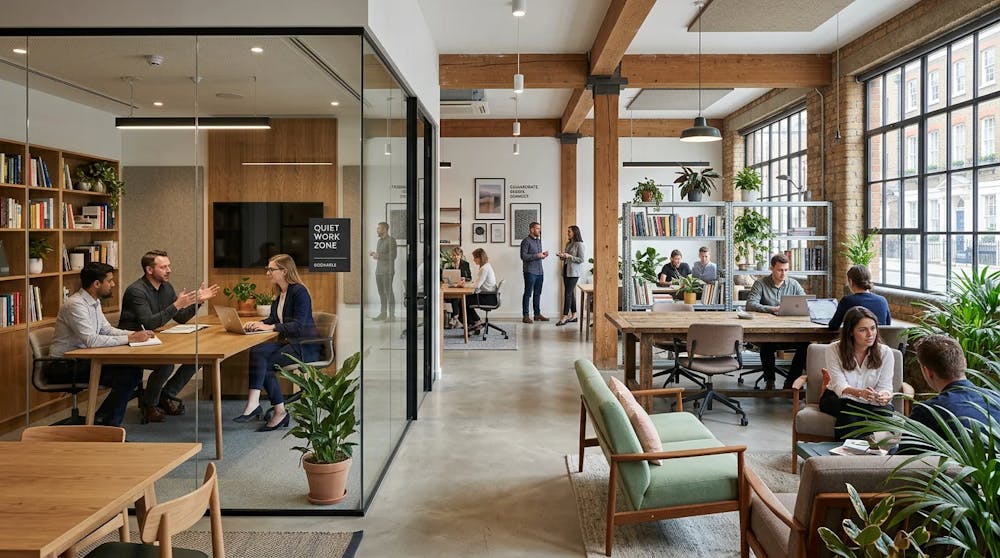
Imagine a lockable room for your team combined with the energy of a shared community, staffed reception, and a rooftop terrace downstairs. That is the appeal driving demand across the UK, where you can compare private office space and coworking options in Bristol without committing to a decade-long lease. The rise of private offices within coworking hubs reflects a wider shift toward workspace that flexes with your headcount and your budget.
Flexible workspace is no longer experimental. According to CoworkingCafe data, the UK is home to 4,270 coworking locations as of Q1 2026, a footprint that confirms shared and serviced space has become standard infrastructure for freelancers, growing teams, and large enterprises alike.
What a private office inside a coworking hub actually means
When people search for private offices in coworking hubs, they are describing a hybrid model. You get an enclosed, lockable room reserved exclusively for your team, while the wider building provides reception, meeting rooms, kitchens, breakout lounges, and social areas shared with other member businesses.
This differs from a traditional lease in two ways. First, the space arrives fully furnished and serviced, so utilities, cleaning, Wi-Fi, and business rates are typically bundled into one monthly cost. Second, the commitment is short. You can scale a team up or down without renegotiating a long, fixed contract. It also differs from open-plan hot-desking, because your team keeps a permanent, private base rather than claiming any available seat each morning.

Why UK businesses are choosing this model in 2026
The commercial case is strengthening. The UK flexible office market was valued at 4.19 billion US dollars in 2026 and is forecast to grow at a 9.15% compound annual rate through 2031, with coworking commanding the single largest segment at 50.85% share.
Several forces sit behind that growth. Hybrid working has settled into permanent policy since the April 2024 day-one flexible-working legislation, and roughly 28% of workers now split their week between home and office. That pattern makes a full traditional lease inefficient, while a private office in a shared hub lets you pay for the footprint you genuinely use. If your business needs a professional address without the overhead of a whole floor, this model answers both concerns at once. You can explore how flexible membership works on our page explaining what we do: coworking and private offices.
Transparent pricing: what you should expect to pay
Cost clarity is where the shared-office model shines, and where hidden extras can catch you out. Median pricing gives you a useful anchor. A monthly coworking membership across the UK carries a median price of £180, while the median day pass sits at £25 in Q1 2026, though central London and Edinburgh command noticeably more.
Private offices priced per desk vary widely by city and building quality. The value of the serviced model is that most costs sit in one predictable figure. For context, the UK serviced offices industry was worth around £3.0 billion in 2026 across roughly 2,445 businesses, a sign of how mature and competitive supply has become. When you review any quote, confirm that utilities, cleaning, business rates, and Wi-Fi are included. Our approach to office rent in Bristol is built around transparent options with no hidden costs, so you can budget with confidence.
| Workspace type | Best for | Privacy | Typical commitment |
|---|---|---|---|
| Block Workspace private office in a hub | Growing teams wanting privacy plus community and amenities | High (lockable, dedicated) | Ultra flexible |
| Hot desk / daily coworking | Freelancers and occasional users | Low (shared seating) | Daily or monthly |
| Dedicated desk | Solo professionals wanting a fixed spot | Medium | Monthly |
| Traditional leased office | Large, stable headcounts | High | Multi-year lease |
The amenities and community advantage
Space is only half the value. The other half is what surrounds it. Providers increasingly differentiate on lifestyle and wellbeing, adding features such as wellness facilities, cafes, event spaces, and rooftop areas to attract and retain members. These are practical benefits, not indulgences: on-site meeting rooms remove the friction of client visits, and shared lounges create the informal collisions that generate referrals and partnerships.
Community is a genuine draw. Coworking environments foster networking opportunities among professionals from different industries, encouraging knowledge-sharing and collaboration that a private lease rarely delivers. Our members enjoy perks like yoga studios, gyms, cafes, and roof terraces alongside their workspace, so a working day supports both productivity and wellbeing.

How to choose the right space for your team
Start with headcount and trajectory. If you expect to add people this year, prioritise an operator that lets you move between office sizes without penalty. Then weigh location against connectivity, cost, and the amenities your team will actually use.
Regional markets deserve attention. London remains dominant, yet cities such as Bristol are established hubs with 64 flexible workspaces recorded in the Q1 2026 industry data. That depth of supply means you can secure quality space outside the capital at more accessible rates. For dedicated team environments, our serviced offices in Bristol combine private rooms with community amenities, giving you a base that grows with you rather than boxing you in.
Conclusion
The direction of travel is clear. With the UK coworking segment holding a 50.85% share of a flexible office market growing at more than 9% a year, private offices within coworking hubs have shifted from novelty to mainstream choice for startups, SMEs, and scaling teams. The model balances the privacy of a dedicated room with the flexibility, amenities, and community that fixed leases cannot match. Choose an operator that keeps pricing transparent, lets you flex terms, and surrounds your team with genuine networking and wellbeing perks. That combination of dedicated space, flexible membership, and vibrant community is exactly what we are built to provide. To find the right fit for your team, explore our head office options in Bristol today.
Frequently Asked Questions
How much does a private office in a coworking hub cost in the UK?
Pricing varies by city, building, and team size, and is usually charged per desk each month with utilities and services included. As a reference point, the UK median coworking membership was £180 per month in Q1 2026. We provide transparent quotes with no hidden costs.
What is the difference between a private office and a dedicated desk?
A private office is a lockable, enclosed room reserved for your team alone, offering full privacy and security. A dedicated desk is a single fixed workstation in a shared area, better suited to solo professionals or freelancers.
Can I scale my team up or down in a coworking hub?
Yes. Flexibility is the core advantage of the model, and many operators let you move between office sizes as your headcount changes. Our ultra flexible membership packages are designed precisely for growing teams that need room to adapt.