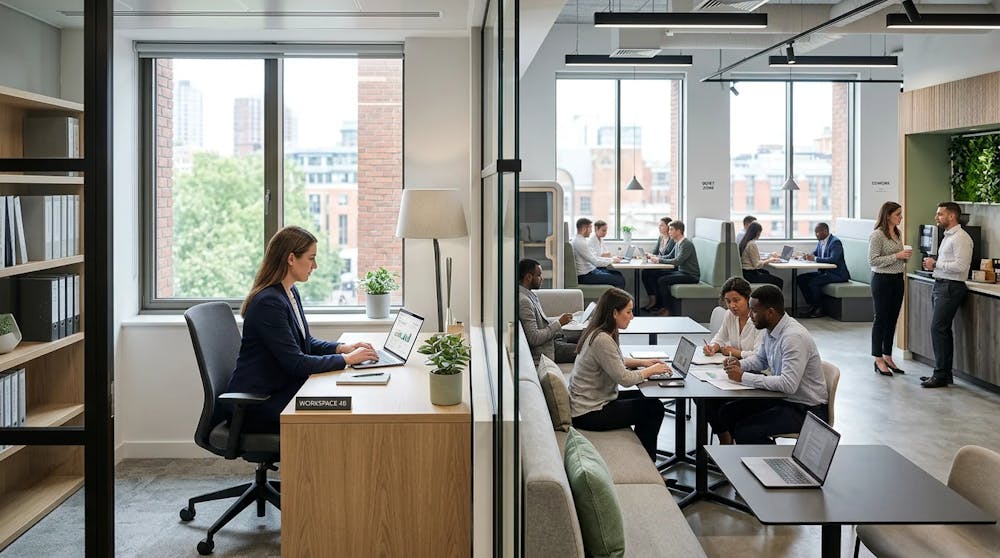
Flexible workspace is no longer a fringe experiment. Deciding between a serviced office and a co-working space now shapes how thousands of British businesses control cost, privacy and growth. The two models look similar from the doorway, yet they differ sharply on price, contract length and the kind of working day they create. If you would like a plain-language primer first, read our serviced offices explainer.
The stakes are meaningful because the sector is large and expanding. The UK flexible office market was valued at USD 4.19 billion in 2026 and is forecast to grow at a 9.15% compound annual rate through 2031. That momentum means more choice, more competition on price and more reason to match the format precisely to how your team actually works.
What a serviced office actually gives you
When people research a serviced office vs co-working space, the serviced office is usually the option that feels closest to a traditional office without the traditional burden. It is a private, fully furnished room or suite inside a managed building, rented on a flexible basis under a single monthly fee.
The provider handles the operational load, so you simply move in and start working. A serviced office typically bundles the following into one predictable invoice:
- Furniture, high-speed internet and phone lines
- Reception staff and on-site building management
- Cleaning, maintenance and utilities
- Access to shared meeting rooms and breakout areas
The trade-off is control. You cannot usually repaint walls, move partitions or brand the exterior of your suite, because the wider floor keeps a neutral, shared aesthetic. For most small teams that is a minor concession in exchange for a professional address and near-zero setup time.

What a co-working space offers instead
A co-working space is a shared professional environment built for a mix of freelancers, remote workers and growing teams. Instead of renting an enclosed room, you buy access: a hot desk you claim each morning, a reserved dedicated desk, or a membership that scales up and down.
The appeal is flexibility and cost. Commitment periods are short, upfront outlay is minimal, and shared resources spread overheads across everyone in the building. You gain a credible place to meet clients without funding an entire office yourself. The recognised trade-offs are noise and privacy, since open floors mean neighbours nearby and few doors to close.
Many operators blur the line by placing enclosed rooms inside the shared building. If you want the community energy of a shared floor with a lockable base of your own, explore our private offices in coworking hubs.
Cost, privacy and flexibility compared
The honest comparison comes down to three levers. Serviced offices carry higher monthly costs because you pay for exclusive, enclosed space; co-working spreads a lower fee across shared resources. Serviced offices win on privacy; co-working wins on scalability and on the ease of adding or removing desks without renegotiating a lease.
Demand for both formats is being driven by how people now work. Roughly 28% of working adults in Great Britain are hybrid workers, according to figures drawing on official ONS data, which pushes teams toward space they can flex week by week.
| Criterion | Serviced office | Co-working space | Block Workspace |
|---|---|---|---|
| Privacy | High (private suite) | Lower (shared floor) | Both: private offices and shared areas |
| Typical cost | Higher monthly fee | Lower, pay for what you use | Ultra flexible packages, no hidden costs |
| Flexibility | Moderate | High | Daily use through to full private offices |
| Community | Limited | Strong | Vibrant, networking-led community |
| Amenities | Standard | Varies | Yoga studios, roof terraces, gyms, cafes |
We designed our memberships around this exact tension. You should not have to choose between privacy and flexibility, and our transparent options remove the hidden charges that make traditional comparisons so difficult.
Community and networking: the deciding factor
Cost and privacy are easy to tabulate, but community is often what changes a business's trajectory. This is where the two models diverge most. In a serviced office, your team works privately and interaction with neighbours stays limited. Co-working is intentionally built for connection, with shared kitchens, events and casual introductions that generate referrals and advice.
For founders without an established network, that difference is not cosmetic. Working alongside other ambitious professionals accelerates problem-solving and opens doors that a closed suite cannot. It also counters the isolation that many remote founders underestimate until motivation starts to dip.
A vibrant community is central to how we operate, which is why our members gain access to lounges, organised networking events and perks such as roof terraces and cafes. If you are exploring the collaborative end of the spectrum, consider our shared office space in Bristol.

Which option fits your business?
There is no universal answer, only a fit. Ask how often you will use the space, how much privacy you need and how quickly your headcount may change over the next year.
- Choose a serviced office if you need a private, professional base, a permanent address and confidential space for client work.
- Choose a co-working space if you are a freelancer, a solo founder or an early-stage team on a lean budget that values flexibility and community.
- Consider a hybrid membership if your needs shift, combining a private office with daily coworking access as the team grows.
Growing teams rarely stay still. If you expect to scale, prioritise a provider that lets you upsize without relocating, so momentum is never interrupted by a move.
How the UK flexible workspace market is shaping the choice
The supply side now works in your favour. The UK and Ireland reached 4,550 coworking locations in the first quarter of 2026, with 4,270 of those in the UK alone, according to CoworkingCafe's industry report. More locations mean more competition on price and terms.
Supply is also spreading beyond the capital. Greater London still leads with 1,209 spaces, yet Manchester and Bristol are among the regional hubs building a strong second tier of the market. That regional depth matters if your team is based outside London and wants quality options locally.
Co-working now commands the largest share of the flexible office segment, and enterprise adoption keeps rising, so the format is no longer defined by freelancers alone. For your decision, the practical takeaway is simple: you have more leverage to negotiate flexible, transparent terms than businesses did even a few years ago.
Making the right workspace call
The decision between a serviced office and a co-working space is rarely about which model is objectively better. It is about matching format to your stage, budget and appetite for community. Serviced offices reward teams that need privacy and a fixed professional base, while co-working rewards those who prize flexibility, lower cost and connection. Map your real usage and growth plans first, then test a shortlist in person. The best workspace is the one that removes friction from your working day and gives you room to grow without penalty.
Take action with Block Workspace
Once you have weighed privacy against flexibility, the next step is seeing the space for yourself. We break the mould of the conventional workspace by combining private offices, daily coworking and lounges under ultra flexible membership packages, with no hidden costs and no surprises.
Whether you need a quiet base for a growing team or a vibrant community to plug into, we offer both alongside perks such as yoga studios, roof terraces, gyms and cafes. Explore our serviced offices in Bristol and choose an option that fits your stage, your budget and your ambitions.
Frequently Asked Questions
Is a serviced office more expensive than a co-working space?
Generally, yes, because a serviced office gives your business exclusive use of a private, furnished room. Co-working spreads costs across shared resources, so the monthly fee is lower. However, the all-inclusive nature of a serviced office can simplify budgeting for small teams.
Can I get privacy in a co-working space?
You can, though open floors mean neighbours are nearby and there are fewer doors to close. Many providers include private phone booths, meeting rooms and quiet zones for confidential work. Choosing a provider with private offices inside the coworking hub gives you both privacy and community.
Which option is better for a fast-growing startup?
Co-working usually suits early, unpredictable growth because you can add or remove desks without relocating or renegotiating a lease. As the team stabilises, a private office or hybrid membership adds the privacy you will eventually need. Our ultra flexible packages let you move between these formats as you scale.
What is the difference between a serviced office and a managed office?
A serviced office is a private space within a shared, multi-tenant building, rented under an all-inclusive fee. A managed office is typically leased as a whole space to one business and can be customised and branded. Serviced offices offer shorter terms; managed offices trade flexibility for greater control.
Do co-working spaces really help with networking?
Yes, the shared design encourages introductions, events and organic referrals that a closed office rarely produces. For founders without an established network, this can accelerate growth and reduce isolation. Community-led providers actively organise events to make these connections happen.